Showing posts with label Tourist spot. Show all posts

Wednesday, 30 July 2014

Kodanad Elephant Training Center - Cochin

Kodanad Elephant Training Center - Cochin
Elephants are an integral part of Indian mythology and culture. In God's Own Country, elephants are often referred to as the sons of the 'Sahya' (the Western Ghats). Once a part of everyday life in Kerala, elephants are the most ornamental and auspicious animals here. No festival or celebration is complete without an elephant procession. Rows of majestically caparisoned elephants, replete with colorful silken parasols form the most spectacular part of any event in Kerala.
Kodanad Elephant Sanctuary  (Kodanad Elephant Training Center) is a rural riverside village in the Ernakulam district of the state of Kerala . Its a popular picnic spot and tourist destination in Kerala too. It is the only elephant rescue and training center in Kerala specialized for rescuing and training stranded adult and baby elephants from the forest regions across Kerala.
In the mornings at the riverside, tourists informally get a chance to experience hands-on bathe and massage of adult and baby elephants under the supervision of its Mahouts. Bathe and massage of elephants are normally done with small flat rocks, and husk of coconuts.
Kodanad offers elephant safari to the visitors at the main park. At the park, the old ‘Kraal’ is maintained to house elephants, which is a structure made of wood compartments that can accommodate up to 4 elephants.
Visitors to Kodanad Elephant sanctuary can watch feeding of elephants as nearly 80% of an elephant’s day is spent on feeding. It is fascinating to watch elephants feeding themselves in their natural environment
Watching baby elephants during their early training years of early life as it takes a lot of training in their early years. The facility is closed on Monday’s for tourists. There is also a ‘mini zoo’ that shelters wild animals which have become unfit for survival in the local forest and some inmates of the zoo are very rare species.
Watching kodanad baby elephants at their infancy and various stages of their growth has become a unique feature that attracts visitors to Kodanad. At least four to six baby elephants are brought in and trained every year. Tourists arrive at Kodanad fascinated by baby elephant’s various stages of development at the Care centre. Training plays an important role for elephants while their brains develop and they learn vital survival and cultural knowledge. The baby elephants at Kodanad are owned and taken care by the Department of Forest. Once they become adults, someone buy them out in auctions. In Kerala, elephants are used for a variety of traditional jobs such as timber loading & wood moving, or as temple elephants for religious Hindu festivals & events.
Kodanad, set on the Southern banks of the Periyar River amid the beautiful high ranges near Perumbavoor, is one of the largest elephant training centers in Kerala. Earlier elephants captured from the Malayatoor forests (the forests in the East and North of Kodanad) were trained here. Since the introduction of a ban on elephant capture Kodanad has been reduced to a training centre. The famous Malayatoor Church is near Kodanad.   Muthanga of Wayanad district and Konni of Pathanamthitta district are two other elephant training centers in Kerala. Another attraction for elephant lovers is Punnathur Kotta, of the neighbouring Thrissur district, where some 40 elephants of the Guruvayoor Temple are groomed.

Tuesday, 15 July 2014

Marine Drive - Cochin

Marine Drive is a picturesque promenade in Kochi. It is built facing the backwaters, and is a popular hangout for the local populace. Marine Drive is also an economically thriving part of the city of Kochi. With several shopping malls it is as an important centre of shopping activity in Kochi. The view of the setting and rising sun over the sea mouth, and the gentle breeze from the Vembanad Lake has made Marine Drive an important tourist destination in Kochi. Hundreds of people (both natives, and tourists) throng the walkway during the evenings.

Marine Drive in Kochi, is a popular hangout and this scenic stretch offers a spectacular view of the backwaters and the Kochi Harbour. The Rainbow Bridge and the International Tourism Boat Jetty Complex are other attractions here.The walkway is usually thronged by people in the evening and the view of the sun setting in the tranquil sea. At night, the place provides a picturesque spectacle with the light seeping out of the anchored ships. The cleanliness, sitting arrangements and the cool breeze from the backwaters are the other factors that draw tourists here.
The beauty of the place has been enhanced by two contemporary constructions – the Rainbow Bridge and the Chinese Fishing Net Bridge.  Childrens’ Park and Subhash Chandra Bose Park are also situated near Marine Drive.  There are various boat services from Marine Drive to take you to tourist spots like the oil tanker berth, the Cochin shipyard, the Bolgatty Palace, Mattanchery Jewish synagogue, Jew Street, Vallarpadom Terminal and so on. 

Marine Drive, with its many skyscrapers and shopping malls, is one of the commercially thriving areas of Cochin. Corporate offices, quality restaurants, showrooms for international names and so, on have found secured their place in the buildings adjacent to the walkway. Apart from being a shopping destination, Marine Drive has a number of apartments that are much in demand.
The boat jetty that operates ferry services to various islands is situated near Marine Drive. 

Monday, 14 July 2014

Jewish Synagogue -Cochin

Jewish Synagogue
Jewish Synagogue or the Paradesi Synagogue is the oldest synagogue in the Commonwealth of Nations, located in Kochi in South India. It was built in 1568 by the Malabar Yehudan people or Cochin Jewish community in the Kingdom of Cochin. It is also referred to as the Cochin Jewish Synagogue or the Mattancherry Synagogue. The synagogue is located in the quarter of Old Cochin known as Jew Town, and is the only one of the seven synagogues in the area still in use. The complex has four buildings. It was built adjacent to the Mattancherry Palace temple on the land given to the Malabari Yehuden community by the Raja of Kochi, Rama Varma. The Mattancherry Palace temple and the Mattancherry synagogue share a common wall.
The Paradesi Synagogue, in a corner of Jew Town, is more than a hundred years old and houses many rare antiques.  The synagogue that woos many visitors, add to the quaint charm of Mattancherry.  The synagogue, the oldest in the Commonwealth, was built by the Jewish community of Cochin. In 1662, it was destroyed by the Portguese and then reconstructed, two years later, by the Dutch.
The word Paradesi means foreigner in many Indian languages. It refers to the White Jews - A mixture of Jews from Kodungalloor, Middle East and Europe.
Enter the synagogue and the large main hall arrests your attention with display of rare antique objects that add to the grandeur of the place. The light falling through the large open windows make the sight of chandeliers and lamps more delightful. These glass chandeliers dangling from the ceiling belong to the 19th century and were imported from Belgium.
The floor of the synagogue itself is a showpiece with the paving of hand-painted blue willow patterned floor tiles. These ceramic tiles were brought from Canton, China in the 18th century by Ezekiel Rahabi, a renowned Jewish businessman. Each tile is different from one another in its design and it never fails to capture the admiration of the visitors. The marvellous construction of the synagogue is revealed in all its features including the splendid pillars.
A pulpit with brass rails is built in the center of the room. An exclusive gallery for women with gilt columns, a carved teak ark etc can be seen in the synagogue.  The teak Ark houses four scrolls of Torah (the first five books of Old Testament) and they are encased in silver and gold. Two gold crowns presented to the Jewish Community by the Kings of Kochi and Travancore are also kept here.
Another valuable possession of the synagogue is the copper plates belonging to the 4th century with inscriptions in Malayalam. The inscriptions describe the privileges granted to the community by the erstwhile Cochin king. It is written in kannadiyezhuthu script or mirror image writing. An oriental rug gifted to the Jews by the last Ethiopian Emperor, Haile Selassie is also kept in the synagogue. 

Sunday, 13 July 2014

Mattancherry Palace (Dutch Palace) -Cochin

Mattancherry Palace
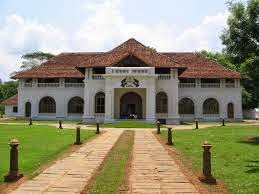
Mattancherry Palace, also known as the Dutch Palace, in Mattancherry, Kochi, features Kerala murals depicting Hindu temple art, portraits and exhibits of the Rajas of Kochi.Mattancherry Palace with its medieval charm is situated at Palace Road, Mattancherry, Kochi. It was built by the Portuguese and presented to Veera Kerala Varma (1537–65), Raja of Kochi, in 1555 AD.
 The palace is a quadrangular structure built in Nālukettu style, the traditional Kerala style of architecture, with a courtyard in the middle. In the courtyard there stands a small temple dedicated to 'Pazhayannur Bhagavati', the protective goddess of the Kochi royal family. There are two more temples on either side of the Palace, one dedicated to Lord Krishna and the other to Lord Siva. Certain elements of architectures, as for example the nature of its arches and the proportion of its chambers are indicative of European influence in basic Nāluketttu style.
The double storeyed palace building which stands by the panoramic Kochi backwaters has an exquisite collection of murals collectively covering over 300 sq ft of its walls. The themes of these murals have been borrowed from the great Indian epics - the Ramayana and the Mahabharatha, and mythology and legends about the Hindu gods especially Guruvayurappan. Some murals depict scenes from Kumarasambhavam and other works of the great Sanskrit poet Kalidasa.
The present museum was established in May 1985 housing a variety of exhibits such as portraits of the Cochin Kings, palanquins, dresses, weapons, three royal umbrellas, canopy, dolis, swords, stamps and coins etc.
The ceremonial dress of the kings with intricate lace work in golden thread woven into them is in display. Also in display are royal caps worn by the Cochin kings. The coins issued by the kings of Cochin and postal stamps are exhibited besides important plans of Cochin drawn by the Dutch in the 17th and 18th centuries.
Also on display are royal paraphernalia like weapons, swings and furniture which offer a glimpse of the lifestyle of the royal family.
Mattancherry palace is located at a distance of 12 km from Ernakulam (Cochin) in Kerala State. The nearest airport is Nedumbaserry international airport. Mattancherry palace is one of the oldest examples of the Portuguese architecture with oriental influence and is unique from the historical and architectural point of view.

Sunday, 6 July 2014

Padmanabhapuram Palace -Thiruvanathapuram

Padmanabhapuram Palace 

The Majestic old wooden palace is situated Thuchlai, 63 kms from Thiruvanathapuram on the way to Kanyakumari. 

The antique interiors are replete with intricate rosewood carvings and sculptured decor. The palace also contains 17th and 18th century murals. One can see: the musical bow in mahogany, windows with colored mica, royal chairs with Chinese carvings, 'Thaikkottaram' or the Queen Mother's palace with painted ceilings, rose wood and teak carved ceilings with 90 different floral designs. 

Durbar Hall of the palace has a with shiny black floor specially made from a combination of egg white, jaggery lime, burnt coconut, charcoal and river sand, granite tubs to cool curd and buttermilk, secret underground passage, the King's bedroom with a four poster medicinal bed, mural paintings, pictures of Lord Krishna, hanging brass lanterns lit continuously since 18th century, open air swimming bath, granite dance hall, Saraswathi temple, large earthen urns, room for scribes and accountants, carved figures on columns holding oil lamps, pooja )worship) rooms with jackfruit tree columns, fish carvings on ceilings, enormous teak beams, Belgian mirrors and an outer cyclopean stone wall fitted together without mortar. 

This palace was once the capital of the State of Travancore. The palace is built in the Travancore architectural style. This is famous for its 17th and 18th century murals, carved mahogany ceiling, colored mica windows, secret underground passages, inner courtyards, durbal hall, museum, four poster medicinal bed, Belgian mirror, pictures of Lord Krishna, granite dance halls and special black shiny floors which are made from a unique combination of egg white, jaggery, lime, burnt coconut, charcoal and river sand. 


Padmanabhapuram palace is very important milestone in Kerala history.

Tuesday, 1 July 2014

Veli - Thiruvanathapuram

Veli
Veli is the most popular picnic destination in Thiruvanathapuram. It is situated 8 km away from the city centre and very close to the Thiruvanathapuram Airport.

The picturesque Veli Lagoon separated by a narrow sandbar from the Arabian Sea, this sandbar is the Veli Tourist Village complete with a waterfront park, floating bridge and great water sports facility. 

A major draw to Veli is the large inland lake separated from the ocean by a narrow sandbar. Set out on a sunset cruise into the Veli Lagoon and watch the water change color from bluish – green to burn orange. Enjoy the tranquil beauty of the lagoon and the Arabian Sea beyond on a pedal boat or row boat.

Fish ponds, wave pools, beautifully landscaped gardens enhance the ambience of the village, and make it look like a jewel, an emerald, on the shimmering waters of the Arabian Sea. 


The Veli Lagoon is famous for sunset boat rides. I visited here number of times with my friends, I enjoyed the beauty of the Veli is very much.

Saturday, 21 June 2014

Marayoor - Near Munnar - Idukki

Marayoor
Marayoor, we can call heaven on earth. Marayoor is located 44 km from Munnar and 55 km from Idukki. The meaning of MArayoor in Malayalam is hidden village. Exotic and unspoiled, Marayoor is a unique place. Here natural beauty meets adventure.

Marayoor offers diversity in every aspect of its land, beauty and culture. Marayoor is the only place in Kerala that has a natural growth of sandalwoods trees. 

There is sandalwood factory run by forest department is the attraction of Marayoor. Another attractions is Muniyaras, Childerns park lies under a Banyan tree (it cover hectors of land) and Thoovanam waterfalls.

Marayoor occupies a vast area on the slopes of the Western Ghats in Idukki district and is an importat pre-historic site in Kerala. Apart from the Dolmenoid cists (Dolmenoids were burial chambers made of four stones placed on edges and covered by the fifth one called the cap stone) in Muniyara.

We can see lush green tea estates in the road from Munnar to Marayoor, and also we can see waterfalls and sandalwood forest.

The relics of the new stone –age culture, consisting of caves, paintings and the underground tunnels, together with places connected with the legendary wanderings of Rama and Sita of Ramayana and the Pandavas of the Mahabharatha make this place archeologically prominent.

Marayoor is known for its tribal culture. We can see cardamom plantations, coffee plantation and Orange grove wild Greek on the way to Marayoor.


In Marayoor, we can see lot of things, we cannot say that to words, you come and enjoy the natural beauty and cultre.

Friday, 13 June 2014

Top Station & Anayirangal- Munnar

Top Station-Munnar
Top station is the highest point on the way of Munnar – Kodaikanal Road. It is 32 km away from the Munnar. The top station is around 1700 m above sea level. The rare Nilakuriji flowers belong over vast area of this region. I said about Nilakuriji some days before, The Nilakurinji blooms every 12 years, at that time all the hill sides covered by blue flowers like a beautiful blue carpet. 

The hill station also offers panoramic view of the neighboring state of Tamilnadu. We can see the Kundalai Dam on the way Munnar – top station road. 

Top Station was a transshipment point for delivery of tea from Munnar to Bodynaakkanur. Top Station derived its name from its being the uppermost located railway station on the Kundala Valley Railway, built in 1902 between Munnar, Kundalai and this hilltop location. A monorail goods carriage system was soon installed along this cart route. In 1908 the monorail was replaced by a 24 inch gauge railway. Middle Station (Kundalai) is 12 kilometers (7.5 mi) west from Top Station on the way from Lower Station Munnar. Some remains of Kundala Valley Railway can be seen at the Munnar Tea Museum.
Tea chests arriving at Top Station from the Kundalai Valley were transported by a ropeway from Top Station 5 km downhill to the south to Kottagudi, Tamil Nadu. The tea was then shipped 15 km by cart to Bodynaakkanur, and then by rail to other places in India and ship to England.Remains of the ropeway station at Top Station is still visible. Elevation at top of Bodi ropeway was 1,911 meters.
Anayirangal

The Anayirangal is the best another sightseeing place in Munnar. Anayiragal is located about 22 KM from Munnar.

We can see lush green carpet of tea plants in this place. Actually a dam is located here, it gives superb views of reservoir, and this dam is surrounded by tea plantations and evergreen forests.

The Anayirankal Dam is surrounded by the Tata Tea Plantation and evergreen forests. Anayirankal is an ideal picnic spot for the travellers from around the world.


If you are lucky enough you will be able to sight large number of elephants that comes to this place often to drink water from this lake.

Thursday, 12 June 2014

Tea Museum - Munnar

Tea Museum
Munnar is famous for tea plantation and tea preserving factories. The owner of Tea museum is Tata Tea Company in Munnar. This museum is located at the Nallathanni Estate of Tata Tea in Munnar.  We can see collection of old bits and pieces from the colonial era. Also we can see demonstration tea production, and learn working of machineries, tea processing, tea tasting. 


The Tata Tea Museum diligently portrays the growth of Munnar tea estates, veritably conveyed through some of the displays like the rudimentary tea roller to the modern fully automated tea factory. Visitors to the museum can satiate their curiosity on various stages of tea processing, and also learn a thing or two about the production of black tea.

A sundial, placed on a granite block, which was made in 1913 by the Art Industrial School at Nazareth, Tamil Nadu, greets a visitor to the Tea Museum. At the museum, if one is curious to locate an item with some antiquity, then the burial urn from the second century BC, which was found near Periakanal estate.

A section of the Tea museum also houses classic bungalow furniture, typewriters, wooden bathtub, magneto phone, iron oven, manual calculators and EPABX of the1909 telephone system.


A demonstration room for tea tasting is another attraction where one would come across different varieties of tea. Those eager to understand the nuances of tea processing can do so at the CTC and orthodox tea-manufacturing unit at the museum. The museum authorities are also contemplating on the idea of allowing tourists to pluck tea leaves themselves and have them processed in their presence. The working hours are 10.00 am to 4.00 pm. 

Wednesday, 11 June 2014

Mattupetty Dam - Munnar

Mattupetty Dam 
One of the main attractions of Munnar is Mattupetty; it is located 13 km away from Munnar Town.  One of the Main attractions in Mattupetty is the beautiful lake and the Mattupetty Dam, which are ideal picnic spot.


The District Tourism Promotion Council, Idukki arranging boating facilities in the Mattupetty Dam. The three types (Speed launch, sow speedboat and motorboat) of boating are available here on payment basis. 


Another main attraction of Mattupetty is the dairy farm run by the Indo-Swiss Livestock Project.  The dairy farm is a unique one of its kind with several varieties of high yielding breeds of cattle.


Tea plantations also we can see here. You are interested for trekking in the Shola forests around Mattuppetty, you can see the variety of birds.


Walk along small streams and follow its meandering path till it falls down the hillside as a waterfall. The hill side is dotted with pretty waterfalls that added attraction of the place.