Showing posts with label Temples. Show all posts

Tuesday, 19 August 2014

Ambalappuzha Sri Krishna Temple - Alappuzha

Ambalappuzha Sri Krishna Temple
Ambalappuzha Sri Krishna Temple  is a Hindu temple in Ambalappuzha, Alapuzha district of Kerala, in south India.
The Ambalappuzha Sri Krishna Temple is believed to have been built during 15th – 17th AD by the local ruler Chembakasserry Pooradam Thirunal-Devanarayanan Thampuran.
The idol at Ambalapuzha is likened to Parthasarthi with a whip in the right hand and a Shankhu (sacred conch) in the left. This temple is directly associated to the Guruvayoor Sree Krishna Temple. During the raids of Tipu Sultan in 1789, the idol of Sri Krishna from the Guruvayoor Temple was brought to the Ambalappuzha Temple for safe keeping.
The payasam served in the Ambalappuzha Temple is famous among Hindu devotees. This sweet pudding made of rice and milk has an interesting mythological legend behind it.  It is believed that Guruvayoorappan reaches here daily at the time of Palpayasa Nedyam to have it.


An idol of Sri Krishna, The Lord Parthasarathy idol was installed in the temple.
The Aarattu festival commences with the flag hoisting ceremony on the Atham star in Meenam (March–April). The important Aarattu festival takes place on the Thiruvonam day of the same month. The aarattu ezhunnullathu starts from Erattakulangara Mahadeva Temple(The famous temple amongst one of the siva temples, facing to west)

Monday, 30 June 2014

Sreepadmanabhaswamy Temple, Thiruvanathapuram

Sreepadmanabhaswamy Temple

Sreepadmanabhaswamy temple is dedicated to Lord Vishnu. It is situated the heart of the Thiruvanathapuram city. The Thiruvanatha puram city got its name after the name of the Lord. The meaning of the word is “The land of Sree Anantha Padmanabha Swamy”. 

The Temple architecture both Kerala and Dravidian Style. It is a grand seven storeyed structure adorned by innumerable stones carvings, ancient inscriptions and colorful murals. There are around 324 pillars in the temple corridor. 

Sree Padmanabhaswamy Temple stands Majestically beside the holy tank, named Padma Theertham, it means the Lotus spring. The Methan Mani or clock tower stands next to the Padmanabha Swamy Temple. It is a historic landmark which is constructed with a highly complex pulley system. 

In 3rd January 1750, Maharajah Marthanda Varma dedicated the Kingdom of Travancore to Lord Padmanabha.  Marthada Varma vowed that the royal family will rule the state on behalf of Lord and he and his descendants would Serve the kingdom as Padmanabha Dasa or the Servant of the Lord Padmanabha. 

Sree Padmanabhaswamy Temple became the richest Hindu Temple in India as well as the world. 


Sunday, 1 June 2014

Mangaladevi Temple, Thekkady- Idukki

Mangaladevi Temple
Today i introducing Mangaladevi Temple. (Inside the Thekkady Forest). This ancient temple is hidden in the dense woods at the top of a peak 1337 M above sea level.


The temple is built in the traditional Kerala style of architecture. Visitors are allowed here only on the Chithra Pournami festival day (once in a year on a full moon day in between the month of April and May).


The peak commands a panoramic view of the other side of the Ghats and the vast plains of Tamil Nadu. Permission to visit the area can be obtained from the Wildlife Warden at Thekkady.


This temple is one of the oldest temples of the region as it is said to be 2000 years old dedicated to Kannagi or Mangladevi. 


Wednesday, 28 May 2014

Kodungallur Amma or Kodungallur Bhagavati Temple

Kodungallur Bhagavati Temple
Kurumba Bhagavati Temple (alternatively Kodungallur Bhagavati Temple) is a Hindu temple at Kodungallur, Thrissur district The idol of the goddess Bhadrakali (popularly known as "Kodungallur Amma") in the temple is unique as it has eight hands with various attributes. 
Kurumba Bhagavati Temple is where Kannaki, heroine of Ilango Adigal's Tamil classic Silappathikaram attained salvation.  During the reign of Later Cheras, Mahodayapuram (Kodungallur) was the capital of the state and one of the most important parts of the region.
It is said that sixth avatar of Vishnu, Sage Parasurama built this temple for the prosperity of the people. According to the old chronicles, this Bhagavathi temple was created in the heart of the town many centuries ago to serve a special purpose. 
Legend says that, after the creation of Kerala by Parasurama, he was harassed by a demon called Daruka. To kill this evil demon, Parasurama prayed to Lord Shiva for help. As advised by Shiva, Parasurama constructed the shrine and installed the Shakti Devi as Bhagavathi/Bhadrakali. The deity in the temple, it is believed, is Parashakthi herself. According to legends, it was Bhadrakali who killed the evil demon Daruka.
According to another belief, the Kannagi came to Kodungallur and prayed to Godess Bhadrakali of Kodungallur. She got absorbed to Bhagavathy idol. 

The temple is situated in the middle of a plot of land about ten acres, surrounded by banyan and peepal trees. The srikovil is facing north. The western chamber of the inner temple is the seat of Sapthamatrukas (Seven Mothers) who also face north. The idol of bhagawati is about seven feet high and made of wood, carved from a jackfruit tree. The idol has eight arms that carry weapons and symbols. About fifty metres away to the left is a sacred pond (Pushkarini), where devotees bathe before entering the main shrine. It is believed that this pond was created by the goddess by striking the ground with her sword. 

Bharani Festival

 The Bharani festival at the Kodungallur Bhagawati temple is one of the grandest in Kerala. It is a month of festivities from the Bharani asterism in the month of Kumbham to 7 days after the Bharani asterism in the month of Meenam. It normally falls between the months of March and April. The festival usually starts with the ritual called 'Kozhikkallu moodal' which involves the sacrifice of cocks and shedding of their blood, which forms an important feature of this temple. The members of the Kodungallur Bhagavathy temple are allowed to participate in this ritual. It is to appease the goddess Kali and her demons who take delight in blood offerings.
'Kavu Theendal', another important event of the festival, overseen by the King of Kodungallur  where Vellichapads (oracles) make a run around the temple waving their sabres in the air while the members of their retinue offer reverence over the inner quadrangle. They make cry of abuse at the goddess in bawdy language. Their abuse is said to be accepted by the goddess followed by the purification ceremony the next day. Chandanapoti Charthal is yet another festival of smearing the image with sandal paste.
 Thalappoli Festival
The Thalappoli festival is in the month of Makaram (January–February). The four day Thalappoli commences from the evening of Makara Sankranthi with religious rituals. Big processions headed by richly caparisoned elephants are taken out to the accompaniment of Pancha Vadyam, Paancari, Paandi, etc.  

Monday, 26 May 2014

Thiruvanchikulam Temple

Thiruvanchikulam Temple

The Thiruvanchikulam Siva temple is located at Thiruvanchikulam 2 kilometers from Kodungallur in Thrissur district, Kerala. The presiding deity is Lord Siva in ‘Sada Siva’ (calm) form. The place Thiruvanchikulam itself have both religious and historical significances. It was the capital of Chera dyanasty ruled here till the 13th century. The ancient seaport town Musiris (the lost city) and the Sree Kurumba Bhagavathy temple are the first things one notice in Kodungallur.


The temple is believed to be built by Cheraman Perumal, a legendary Chera king. It is also believed that Cheraman Perumal (also called as ‘Kulasekhara Perumal) and his minister and friend Sundaramoorthy Nayanar left their life in the temple. There are two idols in this temple, considering as two ‘upadevas’ (sub gods), of them. This is the temple having the largest number of Upadevas in Kerala.


The temple is located in a place namely ‘Cheraman Parambu, and is believed to be the ancient palace spot of the Cheras. The main event in the temple is ‘Dhambathi Pooja’ (couple offering), in which worships the Siva-Parvathy dual and lead them to the ‘Palliyara’ (symbolically their personal bed room). It is believed that the ‘Palliyara Darshanam’ give bliss for overcome hurdles in good marriage and child fertility. The temple is well stored with ancient murals, woodcarvings and ‘Salabhanjikas’ (sculptures), which are worth seeing.


The temple has very good mural paintings and is a protected monument by the Archaeological Survey of India. The temple has the oldest reference in history in old Tamil Sangam literature, references to Sundara Murti Nayanar, and Ilango Adikal, the Chera prince who was the brother of Cheran Chenkuttavan can also be seen in the temple premises. The temple is one of the oldest Shiva temples in South India where Lord Shiva is said to live along with his whole family.


This temple has got a healthy relation with Chidambaram temple in Tamil Nadu. Capital city of Kulasekharas, Mahodayapuram was built around the temple and was protected by high fortress on all sides and had extensive pathways and palaces. This temple was attacked and damaged during Tipu Sultan's invasion of Kerala, the copper roofing and gold and jewels were looted. Tipu's Muslim soldiers fled the temple complex only after the arrival of Travancore Army of Dalawa Keshavadas Pillai. This temple was rebuilt by Paliath Achan of Kochi/Perumpadappu Swaroopam.


Thursday, 22 May 2014

Arattupuzha Pooram - Thrissur


Arattupuzha Pooram

Arattupuzha Pooram is take place in front of the famous Sree Sastha Temple. The Temple has more than 3000 years old. This temple hosts the most ancient and the world’s second oldest festival Devamela. Devamela is a festival when all the gods and goddesses assembly. 


Arattupuzha temple is located on the bank of the Karuvannur River. The Arattupuzha pooram is popular, even though it is much less famous than the Thrissur Pooram.


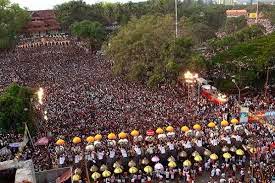
The Arattuppuzha Pooram is commonly refers to as the “grand-father of all Poorams”. On the sixth day of the seven day festival at Arattupuzha temple, 61 daily caparisoned elephants gather in the temple grounds, accompanied by the temple music of Panchavadhyam, Nadswaram, Pancharimelam and Pandimelam.


The famous Sree Sastha temple is situated at Arattuppuzha, a beautiful, quiet village located 15 km away from Thrissur Town. 

Tuesday, 20 May 2014

Koodalmanikyam Temple


Koodalmanikyam Temple

Koodalmanikyam Sree Bharatha Temple is situated 25 Km away from Thrissur, located Irinjalakuda, a small town in Thrissur District of Kerala.  This is the only temple in India dedicated to Lord Bharata, the brother of Lord Rama .Koodalmanikyam is the Malayalam translation of the Sanskrit word Sangameswara.


Koodalmanikyam Bharatha Temple is also one of the four temples in Kerala which form a set known as Nalambalam (Four temple), of which each temple dedicated to the 4 brothers Rama, Bharata, Kakshmana and Shatrughna of the Hindu epic Ramayana.


The Sanctum Sanctorum is round shaped and is covered with copper plates. A Six-foot Thazhikakkudam at the pinnacle adds to the beauty and majesty of the total temple complex.  On the Southern courtyard is the well-known Koothambalam, the Natyagraha for Koothu and Koodiyattam.


Koodalmanikyam Temple is a marvel in architectural beauty. The impressive gateway, round shaped Sactorum, the Majestic Koothambalam and the Carvings in wood and stone on the walls all attracts students of Art and Architecture. The Murals on the walls on either side of the Eastern entry to Chuttambalam also deserve special mention.


The Temple had also been an important centre of nourishment of the Temple Arts like Kathakali, Koothu, Koodiyattam and Thullal. 

Thursday, 8 May 2014

Guruvayoor Temple - Thrissur


Guruvayoor Temple - Thrissur

Guruvayoor Temple

“Om Namo Bhagavathe Vasudevaya”

The Guruvayoor Sree Krishna Temple is one of the most promising places of warship for Hindus. It is also called Bhooloka Vaikundam (The holy abode of Vishnu on Earth). It is located in the Guruvayoor Town of Thrissur. The presiding deity is Mahavishnu, in standing posture with four hands carrying Sankhu (Conch), Sudarshana Chakram (A serrated disk), lotus and mace.  The idol is made of a rare stone known as Patala Anjana.

 The glory of Guruvayoor – the place has been also come to be justly known as the Dwaraka of the south- thus rests on the idol installed there which represents the full manifestation of the Lord Mahavishnu was revealed to Vasudeva and Devaki at the time of Krishnavathara.


The Anakotta is the important place to visit Guruvayoor. It is the Guruvayoor Devaswam elephant sanctuary. It is one of the largest elephant sanitariums in all over the world. It is also known as Punnathurkotta. It is situated 3 km away from the Guruvayoor Temple.

I was visited number of times to Guruvayoor Temple, and I will go in future also.